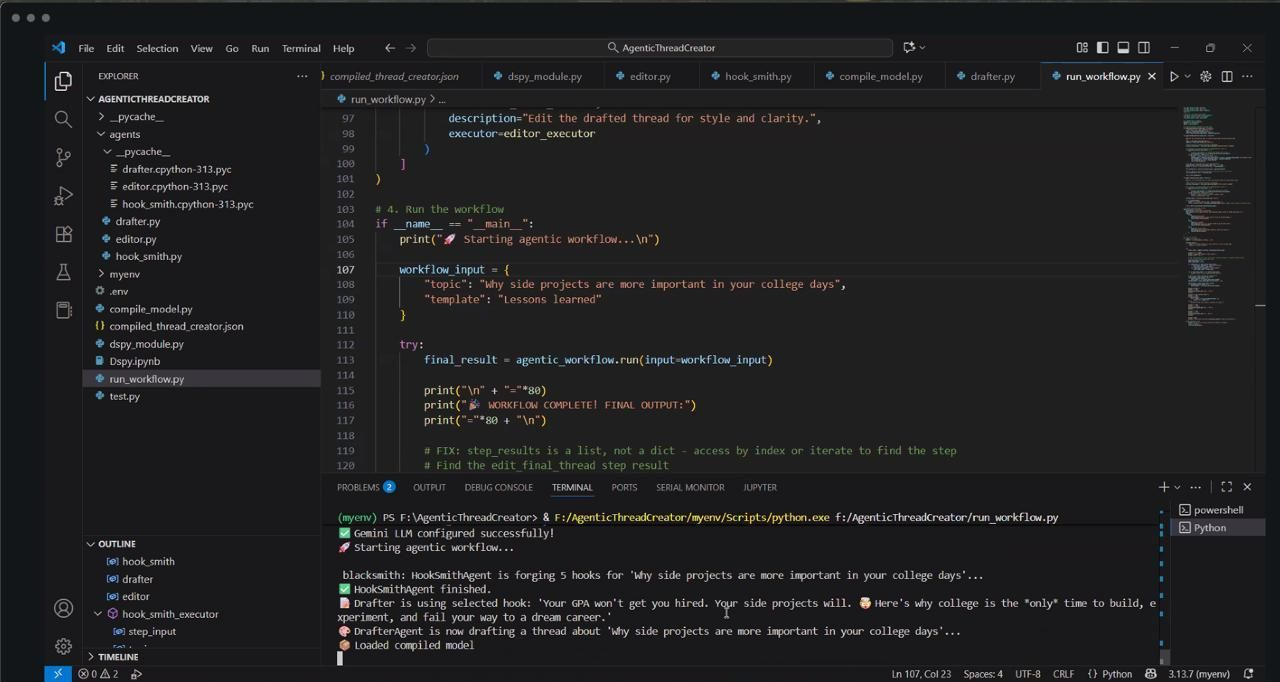
Description:
Agentic Twitter Thread Creator is an agentic AI system built to generate high-quality, engaging Twitter/X threads by following proven writing frameworks instead of relying on generic LLM outputs. The system transforms a topic, notes, or rough draft into a publish-ready thread (≤15 tweets) complete with a strong hook, clear structure, TL;DR, and CTA.
This project was developed under the mentorship of Mr. Bargava (Alumnus) and as part of an internship at PinHead Analytics, with a strong focus on building production-grade agentic AI systems rather than demos.
1. Core Idea
Instead of a single prompt → response flow, the system mirrors how real writers think and iterate through a multi-step agentic pipeline:
source → filter → model → structure → draft → refineEach stage is handled by a specialized agent, enforcing clarity, scannability, and structure.
2. High-Level Flow (Agentic)
def generate_thread(input_data):
    template = infer_template(input_data)
    hooks = generate_hooks(template, input_data)
    best_hook = rank_hooks(hooks)

    outline = create_outline(template, input_data)
    draft = draft_thread(outline)

    tldr = generate_tldr(draft)
    cta = generate_cta(draft)

    return enforce_constraints({
        "hook": best_hook,
        "tweets": draft,
        "tldr": tldr,
        "cta": cta
    })
3. What the System Does
- Accepts topic / notes / rough draft as input
- Learns patterns from real, high-performing Twitter threads
- Selects the most suitable thread template
- Generates and ranks multiple hook candidates
- Produces a structured thread containing:
- Hook
- Body tweets (≤15)
- TL;DR
- CTA
- Outputs ready-to-publish text + structured JSON Example output:
{
  "template": "checklist",
  "hook": "Most people waste years writing threads no one reads.",
  "tldr": "Structure beats inspiration every time.",
  "tweets": ["1/ …", "2/ …", "…"],
  "cta": "Follow for more writing systems."
}
4. DSPy Prompt Programming (Key Differentiator)
Instead of static prompts, DSPy modules are used to program the LLM.
class GenerateHook(dspy.Module):
    def forward(self, topic, audience, angle):
        return dspy.Predict(
            "Write a scroll-stopping hook using Ship30 principles"
        )(topic=topic, audience=audience, angle=angle)
DSPy’s compiler is used to optimize prompt behavior against a labeled dataset of real threads.
5. Agentic Architecture (Agno-style)
Each step is handled by a dedicated agent:
agents = [
    RouterAgent(),
    TemplateSelector(),
    HookSmith(),
    Outliner(),
    Drafter(),
    Editor(),
    TLDRWriter(),
    CTAWriter(),
    Limiter(max_tweets=15),
    Verifier()
]
The workflow is deterministic, reviewable, and debuggable step by step.
6. Automation & Data Pipeline
n8n → scrape threads
     → filter by quality
     → store in Supabase
     → label templates & hooks
     → feed DSPy training/evals
Supabase stores:
- Raw threads
- Labels (template, hook type, CTA)
- Evaluation scores
- Run metadata for reproducibility
7. Evaluation & Guardrails
assert tweet_count <= 15
assert hook_present
assert tldr_present
assert cta_present
Additional checks:
- Readability score
- Hook stop-scroll score
- Claim groundedness (source-backed or opinion-only)
- Side-by-side comparisons (Base vs DSPy vs Human-edited)
8. Why This Project Stands Out
- Uses real creator data, not synthetic examples
- Enforces Ship30for30 writing discipline
- Agent-based iteration instead of one-shot generation
- Designed as a production-grade agentic API
- Strong focus on evaluation, structure, and reproducibility
9. Tech Stack
- Language: Python
- LLMs: Gemini / GPT (pluggable adapters)
- Prompt Programming: DSPy
- Agent Orchestration: Agno
- Automation: n8n
- Data & Storage: Supabase
10. Project Status
- Core system fully implemented
- Dataset curated and labeled (500 threads)
- DSPy prompts compiled and evaluated
- Currently in deployment & packaging phase
- Planned launch as a SaaS product — coming soon 🚀